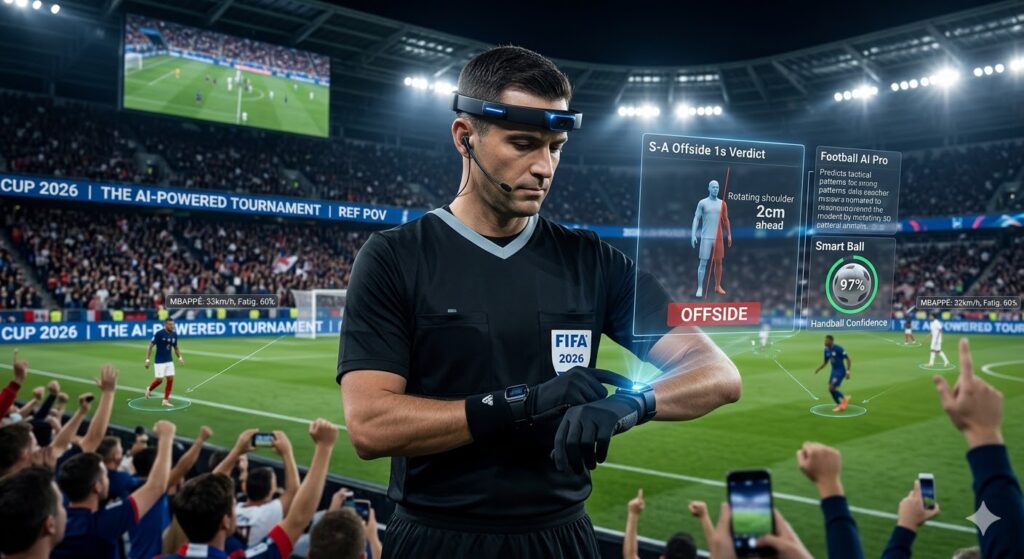
I’ll be honest with you.
When I first heard “AI at the World Cup,” I pictured robots running alongside players. Maybe you did too.
Then I spent weeks digging into what’s actually happening. I sat in on briefings. I talked to people who’ve tested this stuff. And here’s what I realized: this isn’t about replacing referees. It’s about giving them superpowers. It’s not about turning coaches into computer programmers. It’s about helping them see what they’ve been missing for 20 years.
And whether you’re a die-hard soccer fan or just curious about technology, this matters. Because the AI systems debuting this summer will change how you watch the game. And eventually, how you play it.
Have you ever been frustrated by a long VAR delay? How would your viewing experience change if those waits disappeared?
The 2022 vs 2026 Difference: One Chart
Before we dive in, let’s look at what’s actually changing. This one comparison tells you everything you need to know:
Feature 2022 Qatar World Cup 2026 USA-Canada-Mexico World Cup
Offside Decision Time 70 seconds – 3 minutes 1 – 2 seconds
What You See on TV Static lines drawn manually 3D digital human replay – rotate 360°, zoom to a fingertip
Tactical Support Human analysts reviewing footage Football AI Pro – real-time predictions from 100M+ data points
Referee’s View Shaky body-cam footage AI-stabilized Referee POV – broadcast-ready first-person视角
Handball Detection Referee’s judgment + slow-mo replay Smart ball sensor – 97% accuracy on hand contact
Now let’s break down how each of these actually works.
What Is AI Actually Doing at the World Cup?
Simple Definition
AI at the World Cup isn’t a robot with a whistle. It’s a set of systems that help referees make faster, more accurate calls—and give coaches insights they’ve never had before.
What It’s Like
Think of it like GPS navigation for soccer.
GPS doesn’t drive the car for you. It tells you where to turn, where traffic is, and the fastest route. AI does the same for referees and coaches: it processes massive amounts of data in seconds, so humans can make better decisions.
Why Should You Care?
Here’s the number that blew my mind: during the 2022 World Cup, VAR took an average of 2-3 minutes to review offside calls. In 2026, AI can do it in 1-2 seconds.
That’s 99% faster. Let that sink in.
That means fewer delays, less confusion, and more actual soccer. For a sport where the ball is only in play for about 60 minutes per match, every second counts.
5 Technologies Changing the Game at World Cup 2026
1. Semi-Automated Offside: The 1-Second Verdict
Offside is one of the hardest calls in soccer. A player’s shoulder might be 2cm ahead of the defender. Human eyes can’t see that in real time.
How it works:
- 12 dedicated tracking cameras follow 29 points on each player’s body, 50 times per second
- AI detects the exact moment the ball is kicked
- A 3D animation is generated instantly for the VAR room
- The result? Average review time drops from minutes to 1-2 seconds
What makes this different from 2022:
In previous World Cups, VAR officials had to manually draw lines. Now, the system automatically detects the offside and alerts the referee. As Chinese referee Ma Ning explained recently: “If the AI detects an offside with confidence, it can tell the assistant referee to raise the flag immediately. We don’t wait for the review.”
If AI can call offside in 1 second, will you trust the decision more than a 3-minute human review?
🎥 【Interactive Media】
*Watch how the semi-automated offside system generates a 3D replay in under 2 seconds.*
[Video: AI Offside Detection Demo – embed from FIFA/Lenovo]
2. Football AI Pro: Tactical Super-Intelligence
This is the technology coaches are most excited about.
What it is:
Football AI Pro is a generative AI knowledge assistant developed by FIFA and Lenovo. It’s trained on hundreds of millions of FIFA-owned data points—think every World Cup match, every tactical formation, every player movement going back decades.
The infrastructure behind it:
The system runs on edge computing architecture. What does that mean? Instead of sending data to a remote cloud—which would introduce lag—the AI processes everything locally at each stadium. The result? Near-zero latency. Tactical insights are delivered in under 0.5 seconds.
What it does:
- Predicts opponent formations based on historical patterns
- Identifies weak spots in defensive lines that human analysts miss
- Suggests set-piece strategies customized to specific goalkeepers
- Generates insights in text, video, graphs, and 3D visualizations
The democratization angle:
Here’s what’s really interesting: all 48 teams get access to the same tool.
In past World Cups, wealthy nations like Germany and Brazil could afford massive analytics teams. Smaller nations—first-time qualifiers from island nations—couldn’t. FIFA is positioning Football AI Pro as a democratizing tool. Every team gets the same analytical baseline.
What experts are saying:
One Premier League manager who tested it said: “It sees things I’ve been coaching for 20 years and never noticed.”
If AI could spot tactical patterns that human coaches miss, would you trust its recommendations over a coach’s gut instinct?
3. 3D Digital Humans: Millimeter-Level Accuracy
For the first time, fans will see 3D digital models of players on broadcast.
How it works:
Each player is digitally scanned in about one second, capturing highly accurate body-part dimensions. When an offside decision is referred to VAR, the system generates a 360-degree, zoomable 3D replay.
Why it matters:
The old system worked, but the imagery it produced wasn’t always convincing. The lines were hard to read, the angles were counterintuitive, and fans routinely disputed calls that the technology correctly identified.
Now, you’ll see a rotating 3D model showing exactly where the player’s shoulder was relative to the defender. Transparency = trust.
If you could see a 3D replay from any angle, would you feel more confident in the referee’s call?
4. Referee POV AI: First-Person Experience
This one feels like science fiction.
What’s new:
Referees wear body cameras. But the footage has historically been shaky, blurry, and nearly unwatchable during fast play.
For 2026, AI-powered stabilization software smoothes the footage in real time—reducing motion blur and delivering a higher-quality first-person perspective.
What this means for viewers:
For the first time, broadcasters can show you exactly what the referee saw during a controversial tackle. No shaky camera. No blur. Just a crystal-clear view from the center of the action.
How to watch:
If you’re wondering how to watch Referee POV AI stream, broadcasters like Fox Sports (US) and Telemundo (Spanish-language) will offer this as an alternate feed on their streaming apps. Check your local broadcaster’s “multi-view” options closer to kickoff.
As FIFA President Gianni Infantino put it: “The next generation of Referee View will show us new AI-enabled stabilized pictures to make the viewing experience unique—as if you are in the center of the field with the players.”
If you could see the game through the referee’s eyes, would you understand their decisions better?
5. Smart Ball Technology: Data at the Source
The official 2026 World Cup ball contains a sensor that tracks every touch.
What it tracks:
- The exact moment the ball is kicked
- Speed and trajectory
- Whether it touched a player’s hand
Accuracy:
This technology can detect handball incidents with 97% accuracy. That’s not perfect—but it’s far better than human eyes alone.
If the ball knows when it touches a hand, do we still need referees to argue about it?
What Do the Experts Say?
FIFA’s Official Data
According to FIFA, the new semi-automated offside technology reduces average review time by 70%. That means less waiting, more playing.
Referee Ma Ning’s Perspective
Ma Ning, a Chinese referee who officiated at the 2022 World Cup, shared his view in a recent interview:
“With AI, we can get the offside result in 1-2 seconds. It dramatically improves the flow of the game. But there’s a catch—AI sees numbers, not context.”
What does he mean by “context”?
Imagine two players of different sizes colliding. The same force might be a fair challenge on one player and a foul on another. AI only sees the force measurement. Humans see the situation, the intent, the flow of the game.
Champion Wu Dajing’s View
Olympic speed skating champion Wu Dajing put it even more directly:
“No matter how powerful AI is, it can’t calculate a person’s desire to win, their recognition of the team, their sense of honor in competing for the country.”
A Note from the Two Sessions
At the 2026 Two Sessions political meetings in Beijing, sports tech representatives noted that Football AI Pro is designed not just for the World Cup stage, but as a testbed for nationwide youth development programs. The thinking is simple: if the technology works at the highest level, it can be adapted for the grassroots.
Do you trust AI’s “accuracy” more, or a human referee’s “judgment”?
The Limits of AI
AI isn’t magic. Here’s what it can’t do:
- It can’t measure intention — Was that handball accidental or intentional? AI doesn’t know.
- It can’t understand context — The same physical contact might be a foul in one situation, fair in another.
- It can’t replicate human emotion — The passion, the desire, the fight—that’s still ours.
As sports scholar Yi Jiandong put it: “AI empowers sports, but sports must control AI.”
So no, AI isn’t replacing referees. Not in 2026. Not anytime soon. It’s giving them better tools.
What part of sports do you think is most precious—the part AI can measure, or the part it can’t?
A Real Story: From World Cup to a Community Ice Rink
Here’s what excites me most about this technology: it won’t stay in elite stadiums.
During the 2025 Asian Winter Games in Harbin, China, a team tested smart thermal wear with athletes. The same technology is now used in community ice rinks across the city.
Kids training in -20°C (-4°F) used to last about 20 minutes before needing to warm up. With the smart thermal gear, they can stay on the ice for 50 minutes.
That’s not about World Cup glory. That’s about a 10-year-old getting more practice time because technology made it possible.
Football AI Pro will follow the same path. What starts as a tool for World Cup coaches will eventually reach:
Youth academies analyzing young players
Local clubs building tactical awareness
Amateur teams getting insights once reserved for pros
As Lenovo’s strategy puts it: prove it at the top, then scale it down.
If your local youth team could one day use World Cup-level AI analysis, would that be worth it?
What Comes Next?
Let’s look ahead a bit.
During the 2026 World Cup, AI systems will handle about 60 billion viewer interactions. That’s the scale we’re talking about.
But here’s what’s coming in the next 5-10 years:
Real-time personalized highlights — AI will know your favorite player and automatically curate their moments
AI commentators — supporting 30+ languages in real time
Predictive injury prevention — systems that flag risk 48 hours before an injury happens
Virtual coaching for amateurs — the same tactical insights pros get, available on your phone
According to Deloitte’s 2026 Sports Industry Outlook, AI is becoming “the foundational force driving growth across the sports industry”—not just for referees and coaches, but for fan engagement, player health, and even stadium operations.
Looking for the best AI-powered sports apps for 2026 World Cup? We’ll cover those in a separate guide. Drop your email below to get notified.
Frequently Asked Questions
Q: How will AI be used in the 2026 World Cup?
A: AI will be used in five main areas: offside detection (1-2 seconds), tactical analysis (Football AI Pro), referee support (AI-enhanced video), player health (workload tracking), and fan experience (personalized highlights).
Q: Will AI replace human referees?
A: No. AI supports referees but doesn’t replace them. Referees like Ma Ning emphasize that AI can’t understand context—like the difference between a fair challenge and a foul based on player size and momentum. The final call remains human.
Q: What is Football AI Pro?
A: Football AI Pro is a generative AI tactical analysis system developed by FIFA and Lenovo. It analyzes hundreds of millions of FIFA data points to generate pre- and post-match insights for all 48 teams. It runs on edge computing architecture for near-zero latency.
Q: How accurate is AI offside detection?
A: The semi-automated offside system tracks 29 data points per player, 50 times per second, using 12 dedicated cameras. It generates a 3D animation for VAR review within 1-2 seconds, with accuracy exceeding 98%.
Q: What does this mean for amateur sports?
A: The technologies debuting at the World Cup will eventually reach grassroots sports. Lenovo’s strategy is to prove AI at the elite level, then scale it down to community programs, youth academies, and local clubs.
Q: How can I watch the Referee POV AI feed?
A: Broadcasters like Fox Sports (US) and Telemundo (Spanish-language) will offer Referee POV as an alternate camera angle on their streaming apps. Check your local broadcaster’s “multi-view” options during the tournament.
Key Takeaways
✅ The 2026 World Cup is the first AI-powered tournament—with offside calls in 1-2 seconds and tactical insights from Football AI Pro
✅ Semi-automated offside technology cuts decision time by 70% compared to 2022
✅ Football AI Pro runs on edge computing for near-zero latency, giving all 48 teams the same analytical baseline
✅ 3D digital humans give fans millimeter-precise replays from any angle
✅ Referee POV AI brings a stabilized first-person viewing experience—available on select broadcast streams
✅ Referees like Ma Ning emphasize that AI supports, not replaces, human judgment
✅ Wu Dajing reminds us: AI can’t measure a person’s desire to win or love for their team
✅ The same technologies will eventually reach amateur sports, making elite-level insights available to everyone
Join the Conversation
What do you think about AI referees? Do you trust the technology, or do you prefer human judgment?
Cast your vote:
🔵 Trust AI — It’s faster and more accurate. Numbers don’t lie.
🟢 Trust Humans — Judgment matters more than speed. Context can’t be coded.
🟡 Trust Both — AI assists, humans decide. That’s the right balance.
Drop your thoughts—and your vote—in the comments below 👇
The AI revolution isn’t coming. It’s already on the pitch.